

“Chickpeas may be able to grow on the moon, Texas scientists revealed in a Scientific Reports study recently. The study paves the way for further research on lunar agriculture and may have implications for astronauts’ ability to spend longer stretches of time in space.”
Reading an article about the promise—and maybe even the possibility—of growing garbanzo beans on the moon. Thinking the idea of sustaining life, plant though it might be, in low gravity on that orb pulled my demented mind out of the dim fog of the past and focused it on the bright possibilities of the future.
Wow! Is an Aggie experimental farm on the moon even possible? In concept, it seems simple enough. Get a big green John Deere Moon Tractor with PTO up there and start breaking moon sod and sowing beans. If the tractor breaks down, they can just fix it on site, right? It’s not like they need to rocket it back to the nearest dealer.
Some European experts say the moon’s soil may have enough nutrients to nourish garbanzo beans, but it’s not able to sustain agriculture. Apparently, when moon dirt gets wet and then dries out, it turns hard as concrete.
I say, “What do they know?” Have they ever tried to plant a garden in a Houston backyard and come face-to-face with black gumbo clay? I think not.
To get things started right, they can stop by a big orange box store, pick up a few hundred bags of topsoil, and UPS it to the moon. It’s not like what Mark Watney had to do on Mars. I’m sure those seeds would do just fine with a little Earth topsoil mixed in.
I can see it now. Twenty years from now, a wide lunar field of beans. Over time, they adapt, producing enough chickpeas for the crew to have hummus with every meal.
Thirty years in, the plants are thriving in low gravity, propagating themselves, roots stretching through the dust, looking for more.
What the Moon Aggies didn't notice is that some of that topsoil wasn’t fully sterilized. A couple of microscopic nematodes survived the sterilization, the launch, the landing, and the co-mingling with moon dust—and quietly began evolving.
On Earth, nematodes are harmless, even beneficial. But what happens when they mix with nutrient-rich moon dust and are exposed to low gravity, no oxygen, and unfiltered solar radiation?
Forty years later, conditions are just right to stimulate nematodic romance, and before long—Bob’s your uncle—there are “bazillions and bazillions” (sorry, Carl Sagan) of microscopic nematodes mutating beneath the lunar surface.
Another decade passes. One mutation stands out: the ability to create H₂O from the elements in the moon dust. When that meets the beans’ own reproductive adaptations… well, that’s when things get out of hand.
Within months, the beans outgrow their fields. They spread across the surface, overtaking equipment, then habitats. Within a year, they cover hundreds of acres.
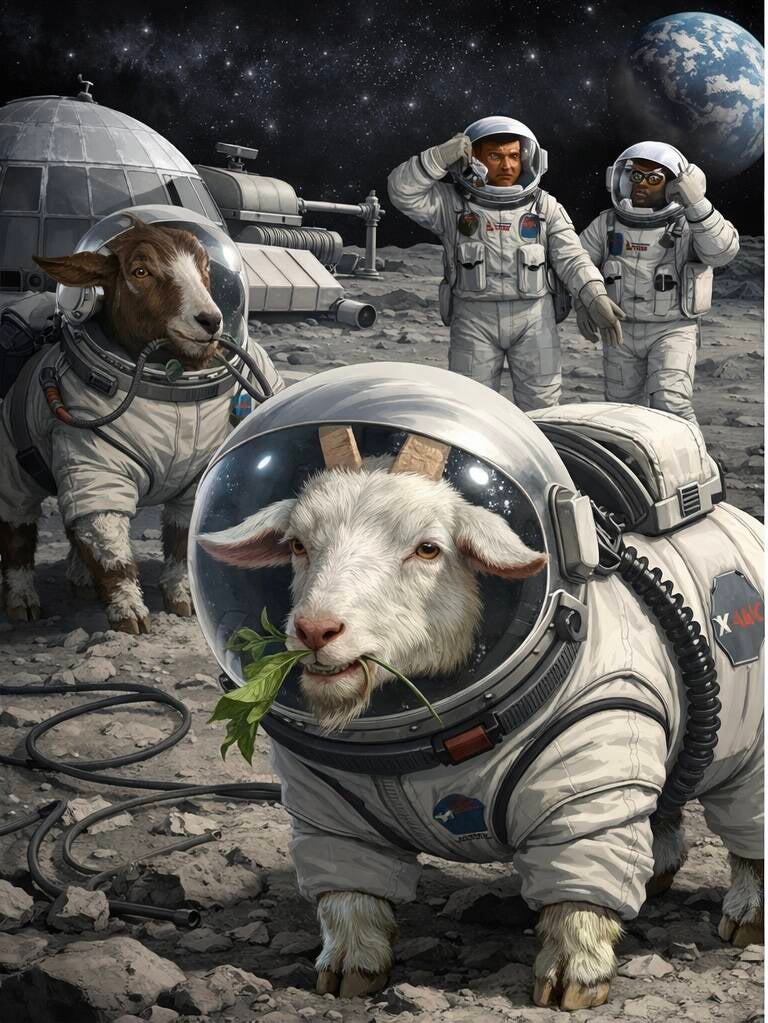
NASA experiments with lunar goats to control the growth, but can’t quite solve the problem of four-legged spacesuits and grazing with open visors.
They consider building Rayovac-powered tankers to spray the moon with Spectracide, but the cost, the attorneys, and the weight of all those “D cell” batteries kill the idea.
Eventually, the project is abandoned. The space Aggies return to College Station to write papers.
For four and a half billion years, the moon’s job was simple: reflect sunlight to Earth. But now the surface is shaded by green leaves. The light fades.
Nights grow darker. Tides grow uncertain. Fishermen can’t tell when to go out, and fish can’t tell when it’s safe to come in. Nocturnal animals lose their edge.
Month by month, the moon dims. No one knows why. Speculation runs wild. The devout repent, the faithful pray harder, the spiritual seek answers, and even the atheists begin to worry.
The government buries the truth—the Great Garbanzo Moon Dilemma—along with the Aggie reports. If word got out about the failed—or wildly successful—Lunar Chickpea Project, careers would end, fortunes would vanish, and lawsuits would bloom like… well… you know.
Fifty years later, NASA detects the first signal ever from the moon.
It isn’t a distress call.
It isn’t a warning.
Just a simple, repeating transmission:
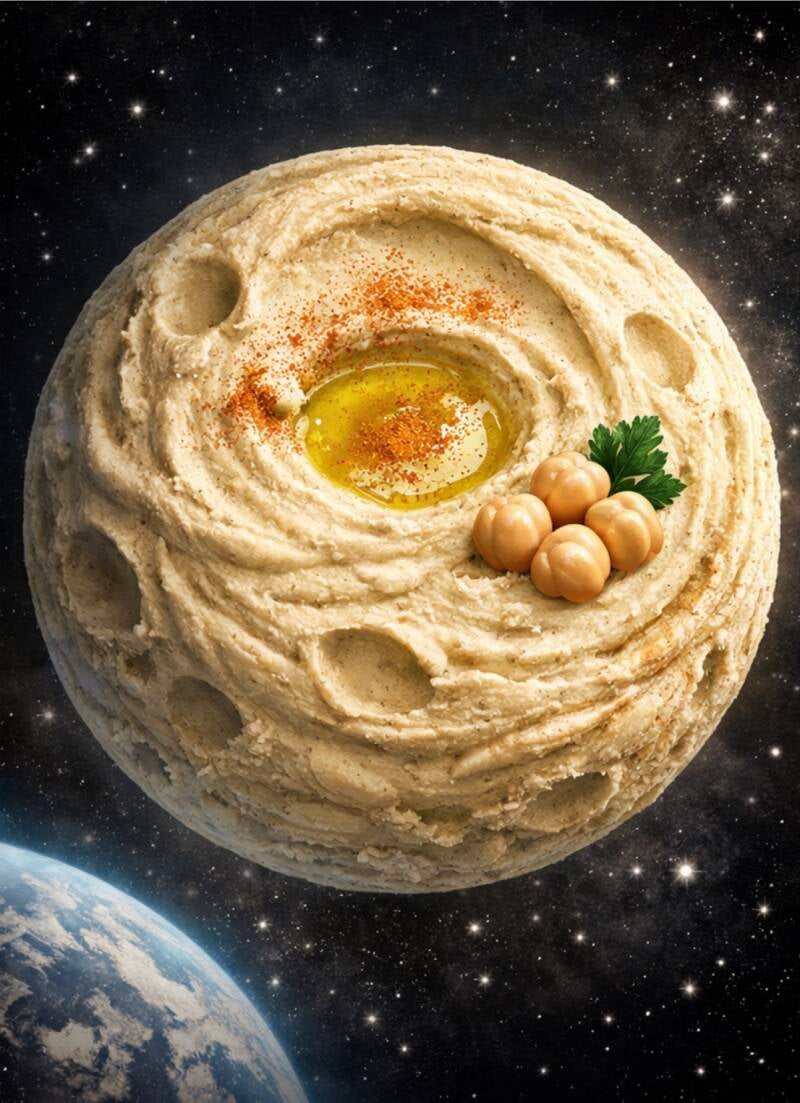
“We are… hummus.”
Scientists confirm it is not a threat.
Just… a declaration.
The beans have organized and achieved spreadable consciousness.
© March 26, 2026 J. Michael Boland

Add comment
Comments