Moon Beans


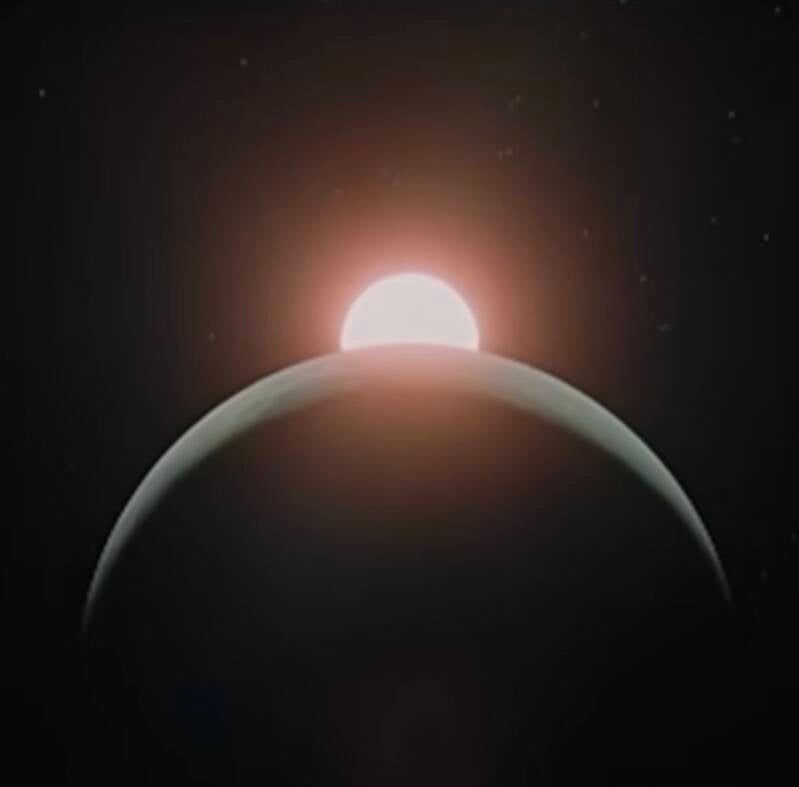
“Chickpeas may be able to grow on the moon, Texas scientists revealed in a Scientific Reports study recently. The study paves the way for further research on lunar agriculture and may have implications for astronauts’ ability to spend longer stretches of time in space.”


Reading an article about the promise—and maybe even the possibility—of growing garbanzo beans on the moon. Thinking the idea of sustaining life, plant though it might be, in low gravity on that orb pulled my demented mind out of the dim fog of the past and focused it on the bright possibilities of the future.


Wow! Is an Aggie experimental farm on the moon even possible? In concept, it seems simple enough. Get a big green John Deere Moon Tractor with PTO up there and start breaking moon sod and sowing beans. If the tractor breaks down, they can just fix it on site, right? It’s not like they need to rocket it back to the nearest dealer.


Some European experts say the moon’s soil may have enough nutrients to nourish garbanzo beans, but it’s not able to sustain agriculture. Apparently, when moon dirt gets wet and then dries out, it turns hard as concrete.


I say, “What do they know?” Have they ever tried to plant a garden in a Houston backyard and come face-to-face with black gumbo clay? I think not.


To get things started right, they can stop by a big orange box store, pick up a few hundred bags of topsoil, and UPS it to the moon. It’s not like what Mark Watney had to do on Mars. I’m sure those seeds would do just fine with a little Earth topsoil mixed in.


I can see it now. Twenty years from now, a wide lunar field of beans. Over time, they adapt, producing enough chickpeas for the crew to have hummus with every meal.


Thirty years in, the plants are thriving in low gravity, propagating themselves, roots stretching through the dust, looking for more.


What the Moon Aggies didn't notice is that some of that topsoil wasn’t fully sterilized. A couple of microscopic nematodes survived the sterilization, the launch, the landing, and the co-mingling with moon dust—and quietly began evolving.


On Earth, nematodes are harmless, even beneficial. But what happens when they mix with nutrient-rich moon dust and are exposed to low gravity, no oxygen, and unfiltered solar radiation? 


Forty years later, conditions are just right to stimulate nematodic romance, and before long—Bob’s your uncle—there are “bazillions and bazillions” (sorry, Carl Sagan) of microscopic nematodes mutating beneath the lunar surface.


Another decade passes. One mutation stands out: the ability to create H₂O from the elements in the moon dust. When that meets the beans’ own reproductive adaptations… well, that’s when things get out of hand.


Within months, the beans outgrow their fields. They spread across the surface, overtaking equipment, then habitats. Within a year, they cover hundreds of acres.


NASA experiments with lunar goats to control the growth, but can’t quite solve the problem of four-legged spacesuits and grazing with open visors.


They consider building Rayovac-powered tankers to spray the moon with Spectracide, but the cost, the attorneys, and the weight of all those “D cell” batteries kill the idea.


Eventually, the project is abandoned. The space Aggies return to College Station to write papers.


For four and a half billion years, the moon’s job was simple: reflect sunlight to Earth. But now the surface is shaded by green leaves.   The light fades.


Nights grow darker. Tides grow uncertain. Fishermen can’t tell when to go out, and fish can’t tell when it’s safe to come in. Nocturnal animals lose their edge.


Month by month, the moon dims. No one knows why. Speculation runs wild. The devout repent, the faithful pray harder, the spiritual seek answers, and even the atheists begin to worry.


The government buries the truth—the Great Garbanzo Moon Dilemma—along with the Aggie reports. If word got out about the failed—or wildly successful—Lunar Chickpea Project, careers would end, fortunes would vanish, and lawsuits would bloom like… well… you know.


Fifty years later, NASA detects the first signal ever from the moon.

It isn’t a distress call.

It isn’t a warning.

Just a simple, repeating transmission:

“We are… hummus.”

Scientists confirm it is not a threat.

Just… a declaration.

The beans have organized and achieved spreadable consciousness.


© March 26, 2026 J. Michael Boland


Act One

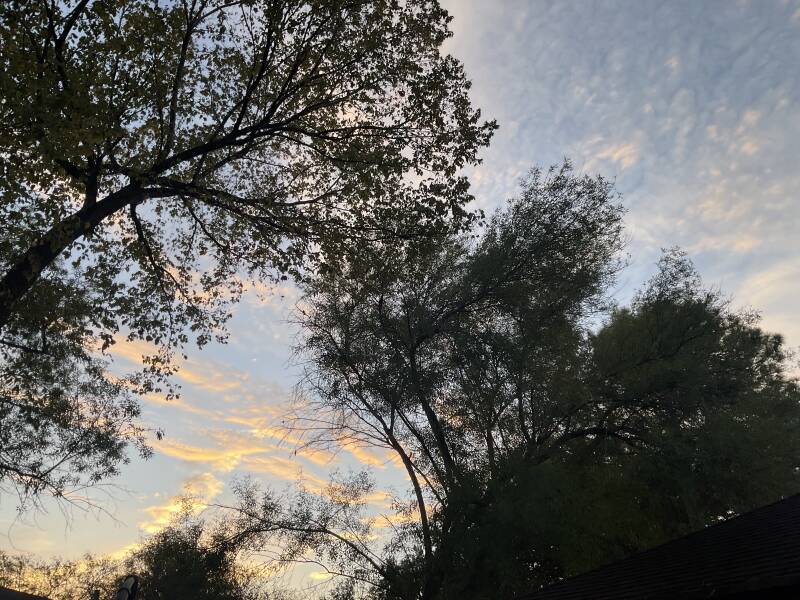
During my almost daily predawn stroll in the cool backyard this morning, I watched the slow transition from night into day. I found myself slipping back to those years working on the theatrical productions at SHSU, when the magic of it all unfolded right in front of me.

How easy it was for my mind to be carried off—to a medieval castle in Richard the Third, a Southern plantation in Finnian’s Rainbow, the streets of New York City in Sweet Charity, or a beach resort in Puerto Vallarta in Night of the Iguana—and plenty more besides. While all the while never leaving my hard wooden seat in the Old Main Theater in Huntsville, Texas.

And it’s here, in that quiet morning light, I realize the scene unfolding in my own backyard isn’t all that different from those stage settings from way back when.  

Curtain Up! Que the bird...

Act One

Walking in the back

hush before curtain

waiting in the wings


The sun makes its entrance, stage left


Just enough light for the set to emerge—

blue scrim above,

the darkened stage below


A lone bird takes its cue,

first line of the morning


I’m still here in the shadows—

where are you?

in the house?


A minute later

the lighting warms, intensifies


Yellow ocher and burnt sienna—

painted sheds revealed in slow fade

against the black floor of earth


Dew-coated green of spring grass

glistens under the rising gels


Right on cue, the sky lifts—

bluer, brighter


The Earth turns its silent revolve


A new act begins


And the eyes and heart of this old artist,

both audience and actor,

receive another fresh canvas


© March 20 2026  J. Michael Boland


Remembering Dawn

Trying something new yesterday, I wrote my first poem that didn’t begin with “Roses are red and Violets are blue…” It was just before the sunrise and I looked up and saw…


Remembering Dawn

The sky to the south at dawn was clear

a beautiful shade of cerulean

SWA 270 has yet to pass

its streaks of titanium white

to mark its trail in the blue yonder

from San Anntone

A brilliant crescent of Moon

Polished silver

still providing its glow to my part of the world

Just slightly east of the Moon 

glowing with Vincent’s blues and grays

vapors off the Gulf starting to float up from the water

Joining together

radiant billows 

in soft Naples yellow

Beginning their cloud journey into the northwest

providing attempts to shade the torrid earth below.   

The Sun was making its morning emanation

warm in Amarillo Indio

Birds greet the peep of day. 

Commuters commencing their rush.

Light greeting the pillowy clouds 

a warm hug of gold and crimson.

Still remembering 

colors

© March 16, 2026 J. Michael Boland


The Night POC Discovered ABBA Philosophy

Ok, Michael J, I’m going to blame this on you, maybe it’s not your fault, but I’m gonna blame you anyway. Well, ok, I started it all with that PP&M post last Saturday, which dug up a lot of old emotion. However, if it wasn’t for our Facebook discussion the other day about your great music collection and all the music that I remembered enjoying, I would not have thought about that group from Sweden, ABBA. It has stuck in my brain like a grass burr in my bare toe ever since. So, to exorcise those Dancing Queens from my head, and after several consultations with Dr. James Beam, this story was concocted as my prescribed therapy and is now presented to you in hopes that Fernando might also pay you a visit in the middle of the night and beat the drums all night long.


My apologies to that Asshole and his lovely wife, Triple Tail in Port O’Connor, Texas, for dragging you and the town into my dilemma, but I had to place this story somewhere.  Ya’ll won!


The Night POC Discovered ABBA Philosophy

Finishing up my business in Victoria, I headed south along Texas 185 toward the coast. Not sure where the road was going, I didn’t really care, and hadn’t planned to make any stops until I got back home. I hoped to drive another fifty miles before dark, but the engine began making a noise that suggested either a loose fan belt or a family of raccoons conducting a labor dispute under the hood.


Just ahead, a big, bright orange sign read “Caution: Guard Rail Damage Ahead.” Later, I would think I should have heeded the warning and turned around.  The next sign simply read, “Port O’Connor”.


I was lucky enough to see a mechanic closing up his shop, and he told me he could look at it in the morning. He pointed me in the direction of the café and a motel right next to the shop. The sign over the motel said it was The Voulez Vous Motel.


The waitress at the café wore a name tag that identified her as Chiquitita. She shrugged and said, “Well, stranger, you might as well take a chance on me and stay the night. Motel’s clean enough.”


That should have been my second warning.


After supper, I wandered into the only bar in town. It had a long wooden counter, a jukebox glowing in the corner, and the sort of crowd that studies newcomers with the same curiosity usually reserved for meteor sightings.

A man asked where I was headed.

I told him the truth—that these days I mostly just follow the road and hope for the best.

“Travel teaches you a lot about people,” I said. “After a while, it’s just knowing me, knowing you, and figuring out which towns have decent coffee.”

They nodded thoughtfully, and someone wrote that down on a napkin.

About that time, the jukebox started playing, and a tanned, silver-haired woman rose from her chair with surprising authority. She moved toward the dance floor like a general entering battle. The crowd stepped aside respectfully. I was told her name was Weslene.

If the world has ever produced a genuine dancing queen, she was standing right there in orthopedic shoes.

Within minutes half the room was clapping along.

A tall man handed me a beer and said, “Every traveler eventually meets his Waterloo.

“Tonight might be yours,” he added cheerfully.

I laughed, which turned out to be a mistake. A microphone appeared in my hand shortly afterward, and before I could object, the bartender had started the music. I have traveled the world and survived questionable food, suspicious boats, and dangerous people, but nothing terrifies me like a microphone in a karaoke bar.

Somewhere behind me a nervous husband was whispering SOS because his wife had decided he should dance too.

By midnight, the whole bar was singing. A woman leaned over and shouted “Mamma Mia!” every time the chorus came around, though I’m not sure she knew why.

The bartender clapped me on the back and declared that around here, the winner takes it all.

I never discovered exactly what prize he thought I had won.


Eventually, someone asked about the best night I ever spent on the road. I told them about a long evening years ago, talking with an old friend beside a river somewhere in South America.

We had stayed up until dawn solving the world’s problems, the way young men do.

“I forget the name of the town,” I said, “but the fellow I was talking with was named Fernando.


For a moment, the whole bar grew quiet, as if I had just revealed an important spiritual truth.

That was when I realized the crowd had begun writing down everything I said.


The mayor arrived sometime after one in the morning. He said his name was Ted, though most people just called him A.H. I can only guess why. He asked if I would mind explaining my philosophy again, slowly this time.

I considered denying everything, but the jukebox started another song, and the entire bar burst into singing.

At that point, I decided it was safer to finish my drink and retreat.


I left town before sunrise while everyone else was still asleep. As I drove away along the empty highway, the lights of the bar faded behind me, and the music drifted faintly across the water.

Whatever else might be said about that town, they certainly believed in celebrating life.


That’s when I saw the flashing red light in my rear-view mirror, and I pulled over.  The officer walked up to my window and asked, “Where are you coming from? and “How much have you had to drink?” I told him about the cafe, but I couldn’t remember the name of the game we were playing, and that I had not had nearly enough to drink.  He checked my license, shone his light on me, and told me to drive carefully, and he was on his way.  He really was a super trouper.


And for that, I suppose, a traveler can only say thank you for the music.


© March 10, 2026

The Terminal Street Rail Road Bridge

The Space Between The Ties


Join me crossing over this old railroad bridge; it’s the only way to get to the other side. Let’s see what can be found on the other bank of the bayou. It’s a little scary — that water is a long way down, and if a train starts heading across when we are in the middle, down may be the only option available. Look at that lush pine and oak forest on the other side. Crossing over with my buddies about 1956, those trees looked, in our eyes, a thousand feet tall. Let’s see what we can see. It might be fun, but crossing that bridge that day was one of the scariest things I had ever experienced in my ten years of life.

That bayou was a long way down. You had to walk on the railroad ties and not step or trip in the empty spaces between them, and the tracks took up most of the bridge’s width. If a train came, there would not be room enough for both of us to pass. One of us would have to step aside to allow the other to go around, and for the one doing the sidestepping, the only place to go would be down. It didn’t take long to figure out which one of us would be giving up the right of way.

Crossing over that old bridge that day was not an easy thing for me to do. I wanted to go back to the familiar safety of my home.

Gary and Howard, my neighborhood friends, kept on going, yelling back to me,

“Come on, let’s see what’s in those woods. Don’t be chicken — cluck, cluck, cluck!”


So I swallowed hard and took that first step, and then the next, trying not to look down, afraid of being caught by some adult authority who would tell my family. Buffalo Bayou was far beyond the limits of parentally approved territory, and the punishment would be severe.

Feeling guilty about my transgressions was a trait deeply instilled in my underdeveloped brain in elementary school by the dear Sisters of de Sade. We would be punished by the rule — the 12-inch rule that would appear in their hands whenever they perceived an infraction of the will of God: not completing homework, poor penmanship — pen, ink, and cursive were still in vogue in those days — or not eating all of your blackened banana. After all, the children in China were starving because they did not obey the rules.

Peer pressure was also a strong influence in my thought process at that time. That cluck-cluck-clucking from those jerks drove me on, maybe more in anger than courage, because I was going to poke the hell out of each of their arms — hard — as soon as I got close enough. Or maybe it was the hopeful promise of feeling safe together with my comrades.

Maybe it was both. Or maybe, deep down, I wanted to cross that divide because it felt like bringing together the two worlds I loved most, though they were torn so far apart. I never knew or remembered living as one family — a mom and a dad together in one place. They divorced when I was only three years old. Remembering much from that age or before was not possible. I lived with Mom and had frequent, fun times with my Dad. There was always, though, a deep longing for unity, even well into my teens.

With all these mixed emotions rushing through me, I continued on with the quest to conquer that scary link connecting the two muddy banks of the bayou.


It was easy enough for my younger self to balance on those rail ties. It was not so easy to look down and see that slow-moving olive-brown water flowing far below and think, if I fall and kill myself, my Dad — the kindest, gentlest man I have ever known — is going to kill me too. It was a double-loss situation.

Eventually, making it across, the sense of accomplishment overwhelmed my emotions enough to make me forget revenge on my buddies — at least for now. The relief of reaching this side of the bayou was only dampened by the apprehension of having to cross back in order to go home again.


Soon after crossing, we continued along the tracks and came across a well-worn path heading down and east away from the rails and deep into the woods. I remember being impressed by how thick the trees and grasses grew together, how tall everything was. Vision was limited to only a few feet on either side. I could hear birds in the upper canopy calling out to their buddies, “Watch out — there are three dangerous boys in the forest, they may be armed - with slingshots.”


It was all so thick and green, and only now have I realized that this piece of real estate was probably then the only — and maybe the last — remaining virgin forest within what is now a massively complex city. It was standing there before Columbus sailed the ocean blue, before Cabeza de Vaca and the Narváez expedition crashed into San Luis Pass in Galveston, maybe even before the Karankawa and the Akokisa people walked this land. Maybe they had trekked along this same trail.


It wasn’t long before we heard voices in the distance. It sounded like a playground at a park. We quickened our pace and burst into a clearing, surprised to see:

  • A cardboard shack big enough for its occupant to sleep comfortably and store his belongings.
  • A small campfire.
  • Four or five other boys hanging around.
  • A grizzled old man in khakis, who turned out to be a hobo living in that cardboard shelter.

“Hello. They call me Capt’n D,” he said, standing up straight after stirring a bubbling pot on the fire to take a look at us.

“The other kids are swinging down by the gully. Just follow that path over yonder — you can’t miss ’em.”

The Capt’n didn’t pay much attention to us hanging around his camp. He just kept doing his chores.


We followed his directions. Not far from the camp there was a deep, dry gully, and tied high up in one of the trees was a long hemp hawser rope that had washed overboard from one of the boats still plying that part of the bayou. Someone had rescued it from being swept down channel and lost forever in the Gulf. Somehow it had been suspended from a heavy limb high in an old oak, and now its sole purpose in life was the fun and adventure of us kids.

The other boys were already there, taking turns, running to catch the rope as it swung back after the previous rider dropped to the ground following his flight to the far side of that deep gully and back again.

My two friends and all the new ones we met were having a great time. None of us gave a single thought to slipping or falling or how far off the beaten track we were in case someone needed a broken arm or leg repaired. We quickly learned that if you just kept hanging on, you’d be all right.

Eventually, we noticed it was getting late and needed to start our return journey home. This time, there was less fear in crossing than before, though I was still careful about where I placed my feet. Making it across, relieved and excited about the adventure, I wanted to tell everyone about the bridge, the Capt’n, the swinging rope, and the fun we had — but as I valued my life, silence would have to rule. This was, after all, a capital offense.


The Final Act — Epilogue


That dense forest on the other side of the bayou is gone now. It gave up the only peaceful serenity for miles around — the last shelter for flora and fauna in that patch of the East End — and was replaced by one of Houston’s large sanitation and aquatic restoration facilities. Unpleasant, perhaps, but essential for a large society that chooses to live close together. You have to do something with all of that;  let's call it waste.


This essay is the first time since that adventure that I have mentioned it to anyone. It seems about time to let my 21st-century kids know a little about the old man’s life back in the day.

While writing, it became clearer that this old river crossing — and others like it — are strong metaphors for overcoming the obstacles life throws in our path. Bridges come in different forms, not only structures over troubled waters but also internal fortitude, perseverance, and determination. They symbolize hope and rising above challenges, the rejoining of what has been divided by the perils of nature. They are paths to opportunities that connect people, places, and ideas. When things are not going well, try to remember how much fun it was swinging over that deep gully below.

Now, at 78 years old, it’s time to think about crossing the next bridge. Again, it’s a little scary — especially knowing it may be the last one. This time, the fear does not come from falling into muddy water but from the journey across the unknown, from not knowing what waits on the other bank.

I was taught that rules must be followed or your soul would suffer the burning fires of hell or some other devilish torment dreamed up in the imagination of Dante Alighieri for eternity. What actually happens is far less clear. There are as many possibilities as there are world religions, and even they disagree among themselves. What is certain is that no one who has crossed the final bridge has ever come back to tell us what lies on the other side.

When the time comes to cross over, I’m just going to think about swinging on that rope — and poking Gary and Howard in the arm when I catch up with them.

© March 5, 2026

Create Your Own Website With Webador